
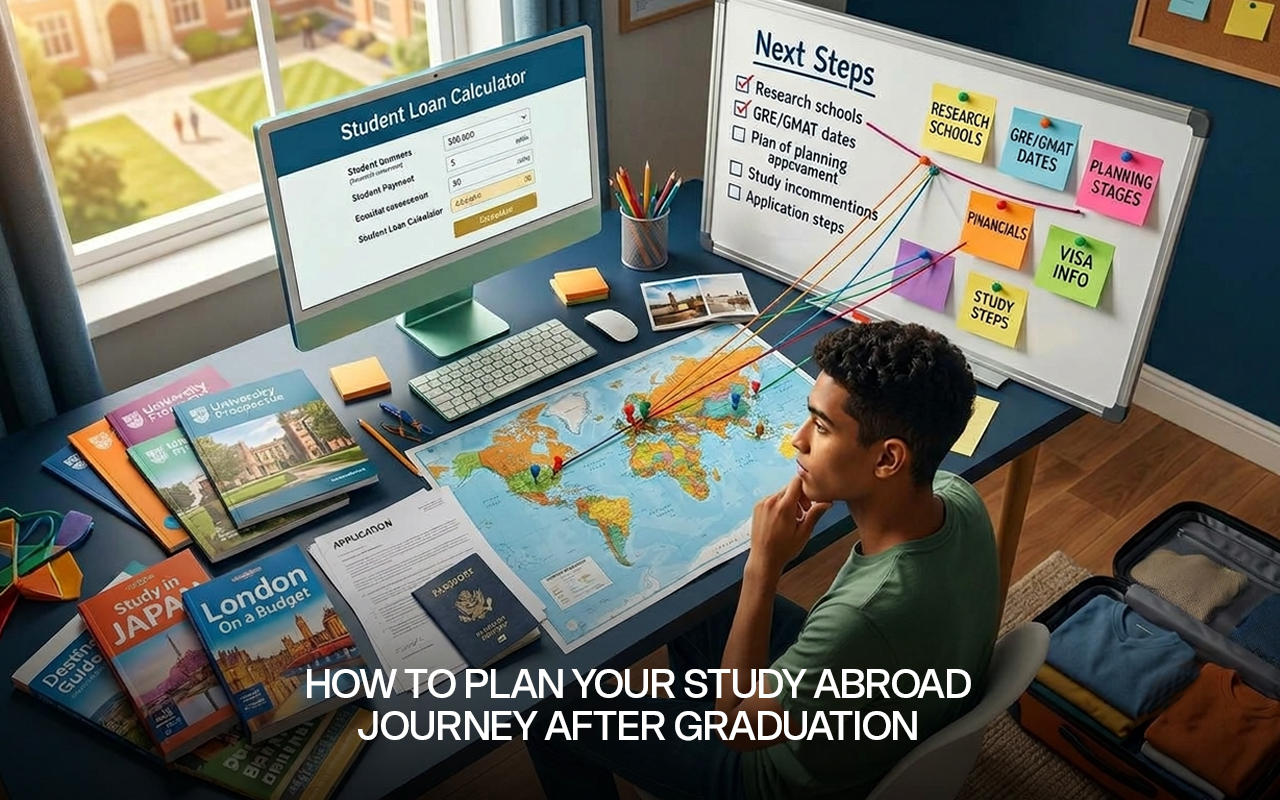
Congratulations on completing your graduation!
Now comes the next big decision: what do you want to do next? You might be thinking about a master’s degree, specialising in your field, switching careers, or finding work opportunities abroad. If studying overseas is on your mind, this is a good time to start exploring your options.
Moving from a college in India to a university abroad takes more than choosing a course and applying for a visa. You need to research universities, prepare your documents, arrange your finances, and understand the opportunities available after graduation.
Here’s a step-by-step guide to help you get started.
1. Identify Your Career Goals Before Choosing a Course
Before shortlisting countries or universities, take some time to think about your career goals. Do you want to specialise in your current field, explore a new area of study, pursue research, or gain skills that are in demand in a particular industry?
For example, an engineering graduate might consider data science, renewable energy, or advanced engineering. A commerce graduate might look into finance, business analytics, or management.
The right course should match your interests and support your future career goals. So, look beyond the course title and check what the programme actually offers.
Go through the curriculum, practical training opportunities, internships, industry connections, and graduate employment outcomes. A university’s reputation matters, but so does the value of the qualification for the career you want to pursue.
2. Choose the Right Country for Your Future
Each country offers a different experience in terms of education, living expenses, lifestyle, and career opportunities. Your choice should depend on your budget, preferred course, and what you hope to do after graduation.
Here are a few destinations worth considering.
Students planning to study in New Zealand can explore programmes that combine classroom learning with practical experience. Before applying, check whether the institution and course are recognised, what the living expenses look like, and whether the qualification meets the requirements for a post-study work visa.
The UK is a popular choice for postgraduate studies, with many master’s programmes that can be completed in one year. This may help you finish your studies sooner, but tuition fees and living expenses can vary considerably depending on the university and location. Check the Graduate visa rules that will apply when you finish your course.
Singapore may appeal to students interested in international business, technology, finance, and other industry-focused fields. When comparing universities, look at the course structure, internship opportunities, and graduate employment prospects. Also, check the work pass requirements if you intend to work in Singapore after completing your studies.
Canada offers a range of programmes across different fields and provinces. If you hope to work there after graduation, check whether your chosen institution and programme meet the current Post-Graduation Work Permit (PGWP) requirements. Eligibility can depend on the programme, qualification, and immigration rules in effect when you apply.
Whichever country you choose, research the specific university and course rather than making a decision based only on the destination’s popularity.
3. Check Admission Requirements and Prepare Your Documents
Once you’ve shortlisted your universities, go through their admission requirements carefully. These can vary depending on your chosen course, previous qualifications, academic scores, and work experience.
Most applications require some or all of the following documents:
- Academic transcripts and semester mark sheets
- Degree certificate or provisional certificate
- Valid passport
- Statement of Purpose (SOP)
- Letters of Recommendation (LORs)
- Updated CV or résumé
- English language test results, if required
- Portfolio, work experience documents, or entrance test scores, where applicable
Many universities accept IELTS, TOEFL, or PTE Academic scores. However, the test you need to take and the minimum score required depend on the university and programme. Some courses may also ask for GRE or GMAT scores.
Start collecting your documents early to avoid last-minute delays. If you haven’t received your final degree certificate, contact the university to check whether it accepts a provisional certificate or other supporting documents.
4. Understand the Full Cost of Studying Abroad
Tuition fees are only one part of your study abroad expenses. You’ll also need to budget for accommodation, food, transport, health insurance, visa fees, flights, study materials, and unexpected expenses.
Prepare a budget for the entire duration of your course. Comparing the overall expenses of different universities will give you a clearer picture than looking at tuition fees alone.
It’s also worth checking the scholarships and financial assistance available to Indian students. These may include university scholarships, merit-based awards, and government-funded opportunities.
If you’re considering an education loan, compare the interest rate, processing fees, collateral requirements, repayment period, and when repayment begins.
Part-time work may help cover some expenses, but don’t depend on it to fund your entire education. Work restrictions vary by country, and finding a job may take time. Make sure you have enough funds to manage your essential expenses even if you don’t find work immediately.
5. Follow a Clear Application Timeline
Starting early gives you enough time to compare options, prepare documents, and meet application deadlines without rushing.
Ideally, begin your preparations 9–12 months before your intended intake. The exact timeline will depend on the university, course, and country.
Months 1–2: Research your options
Shortlist countries, courses, and universities. Compare admission requirements, tuition fees, living expenses, and available intakes.
Months 3–4: Prepare your documents
Take any required language tests, request recommendation letters, collect your academic documents, and work on your Statement of Purpose.
Months 5–6: Submit applications
Complete your applications before the deadlines. Keep track of each university’s requirements and respond promptly if additional documents are requested.
Months 7–8: Review your offers
Compare admission offers, check scholarship options, and decide how you’ll fund your studies before confirming your place.
Months 9–12: Prepare for departure
Apply for your student visa, arrange accommodation, organise travel, and prepare for your move abroad.
This is a general timeline, not a fixed rule. Some universities have earlier deadlines, and visa processing times vary. Always check official deadlines and work backwards from your intended intake.
6. Understand Student Visa and Post-Study Work Options
Receiving an admission offer is an important step, but it doesn’t automatically mean you’ll receive a student visa.
Depending on your destination, you may need to provide proof of funds, academic records, language test results, medical documents, and other supporting information.
If you hope to work abroad after graduation, research your options before choosing a course. Find out whether your qualification meets the requirements for a post-study work visa and what conditions apply.
It’s important to remember that studying abroad doesn’t guarantee a job, permanent residency, or the right to remain in that country indefinitely. Immigration rules can change, so always check the latest information on official government websites before making a decision.
7. Prepare for Life Beyond the Classroom
Studying abroad also means learning to manage daily life in a new country. Along with your academic preparations, spend some time researching accommodation, healthcare, public transport, banking, local laws, and the climate.
Check what support your university offers to international students. Indian student associations and university communities can also help you settle in and get familiar with your surroundings.
It’s equally important to manage your finances, improve your communication skills, and build professional connections through internships, university events, and industry activities.
Before leaving India, keep copies of your important documents and make sure you understand the conditions of your student visa. A little preparation can make settling into a new environment much easier.
Start Planning Your Next Chapter
Graduation is a good time to think about where you want to go next. Whether you’re planning to pursue a master’s degree, specialise in your field, or build a career abroad, the decisions you make now can shape your next few years.
Take time to compare courses, understand the expenses, prepare your application, and research the opportunities available after graduation. The right choice isn’t necessarily the most popular university or destination. It’s the one that fits your goals, budget, and future plans.
Not sure where to begin? Speak to our expert study abroad consultants for guidance on choosing a course, shortlisting universities, and understanding the application process.